

A dental crown covers the entire visible part of a tooth, from the gumline up. It restores the tooth’s shape, strength, and appearance when a filling alone won’t do the job. Crowns are one of the most common treatments in dentistry, and when well made and cared for, they can protect a tooth for many years.
But crowns also cost far more than fillings, so it’s fair to want to know when one is truly necessary, which material to choose, and what to expect.
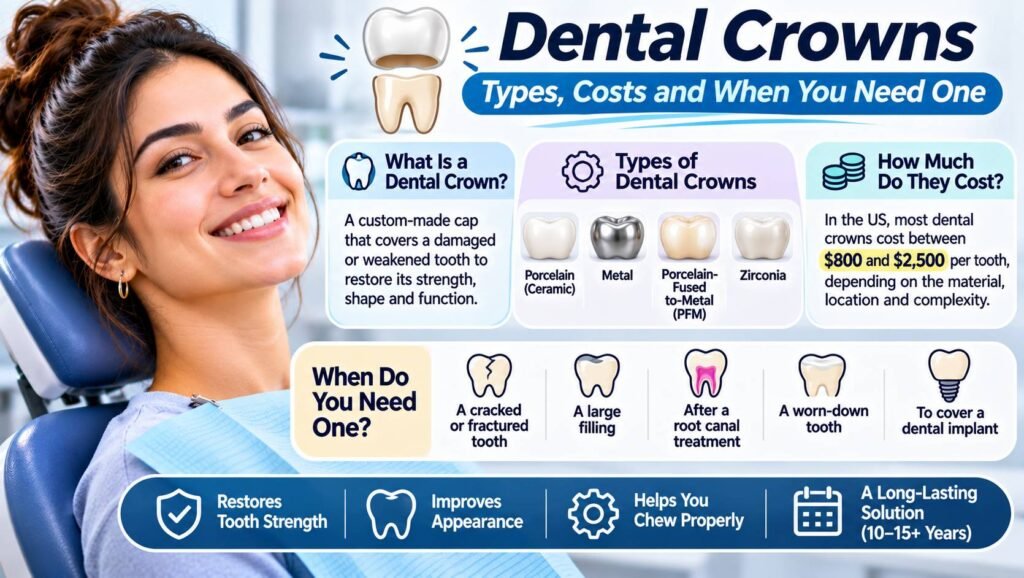
When Do You Need a Crown?
Your dentist may recommend a crown to:
- Protect a weak or cracked tooth from breaking further
- Restore a broken or badly worn tooth
- Replace a very large filling when there isn’t enough natural tooth left to hold a filling securely
- Protect a back tooth after a root canal, since these teeth become more brittle. See root canal treatment.
- Cover a dental implant. See our dental implants guide.
- Anchor a dental bridge. See bridges vs. implants.
- Improve the look of a badly stained or misshapen tooth
When a crown might not be necessary
Sometimes there are alternatives:
- Large fillings can work for moderate damage.
- Onlays or inlays cover part of the tooth’s chewing surface and preserve more natural structure.
- Bonding or veneers may address cosmetic issues on front teeth.
It’s reasonable to ask, “Is a crown the only option, and why do you recommend it for this tooth?” Our list of questions to ask your dentist can help with that conversation.
Types of Dental Crowns
All-ceramic or porcelain crowns
- Most natural appearance
- Good choice for front teeth
- Metal-free, which suits people with metal allergies
- Can be less strong than some other options, depending on the ceramic
Zirconia crowns
- Very strong and durable
- Tooth-colored; newer translucent versions look very natural
- Popular for back teeth and people who grind
- Can be milled same-day in some offices
Lithium disilicate crowns (often known by the brand name E.max)
- Excellent appearance with good strength
- Common for front teeth and premolars
Porcelain-fused-to-metal (PFM) crowns
- Metal base for strength with porcelain on top
- Long track record
- A dark line may show at the gumline over time, especially if gums recede
- The porcelain layer can chip
Gold and metal alloy crowns
- Extremely durable and gentle on opposing teeth
- Need less tooth removal
- Rarely chip or break
- Metallic color makes them less popular for visible teeth
Stainless steel crowns
- Mostly used on baby teeth in children
- Pre-made and inexpensive
- Fall out naturally with the baby tooth
Crown Materials at a Glance
| Material | Appearance | Strength | Typical use |
|---|---|---|---|
| Porcelain / all-ceramic | Excellent | Moderate | Front teeth |
| Lithium disilicate | Excellent | Good | Front teeth, premolars |
| Zirconia | Very good | Very high | Back teeth, grinders |
| PFM | Good | High | Front or back |
| Gold / metal | Metallic | Very high | Back teeth |
| Stainless steel | Metallic | Moderate | Baby teeth |
The Crown Procedure
Traditional crowns (two visits)
Visit 1: Preparation
- The tooth is numbed.
- Any decay is removed, and the tooth may be built up with filling material if a lot of structure is missing.
- The tooth is reshaped to make room for the crown.
- Impressions or digital scans are taken.
- A temporary crown is placed.
Visit 2: Placement (about two to three weeks later)
- The temporary is removed.
- The final crown is checked for fit, bite, and color.
- It’s cemented or bonded in place.
Same-day crowns
Some offices use CAD/CAM technology to design and mill a ceramic or zirconia crown in the office in a few hours. You leave with your permanent crown the same day. Learn more about this technology in digital dentistry explained.
What Does a Crown Feel Like?
During the procedure, you’ll feel pressure and vibration but should not feel pain once numb. Afterward, mild gum tenderness and sensitivity are common for a few days. Your bite should feel normal. If the crown feels high, or you feel pain when biting, call your dentist for a quick adjustment.
Caring for a temporary crown
- Avoid sticky and very hard foods.
- Chew mostly on the other side.
- Slide floss out sideways rather than pulling up, so the temporary doesn’t pop off.
- Call if it comes loose; don’t leave the tooth uncovered for long.
How Much Does a Crown Cost?
In the US, a crown typically costs about $1,000 to $2,500 per tooth without insurance. Factors include:
- Crown material
- Whether a core build-up is needed
- Whether it’s a same-day crown
- Your location
- Lab fees
- Whether a specialist such as a prosthodontist is involved
Dental insurance often covers crowns as major care, commonly around 50%, after your deductible and up to your annual maximum. Some plans have waiting periods for crowns. For more pricing details, see dental care costs in the USA.
How Long Do Crowns Last?
Many crowns last 10 to 15 years, and some last much longer. Lifespan depends on:
- The material
- Your bite and whether you grind
- How well you clean around the crown edges
- Regular dental checkups
- Habits like chewing ice or opening packages with your teeth
Possible Problems With Crowns
- Sensitivity shortly after placement
- Chipping, especially with porcelain layers
- Loose or lost crown if the cement washes out
- Decay at the edge where the crown meets the tooth
- Gum irritation if the crown edges aren’t smooth
- Nerve problems in a tooth that hadn’t had a root canal, occasionally requiring one later
Caring for Your Crown
- Brush twice daily and floss once a day, paying attention to the gumline around the crown.
- Wear a night guard if you grind.
- Avoid chewing ice, hard candy, and pens.
- Keep up with regular cleanings and X-rays so problems at the edges are caught early.
Our guide to maintaining healthy teeth and gums covers daily care in detail.
Crowns for Children
Children sometimes need crowns too, usually on baby molars with large cavities or after a pulp treatment. Pre-made stainless steel crowns are the most common choice because they’re durable, quick to place, and inexpensive. Tooth-colored zirconia crowns are also available for kids, especially on front teeth, though they cost more. These crowns fall out naturally with the baby tooth. A pediatric dentist can explain whether a crown or another treatment makes the most sense for your child.
What to Do If a Crown Comes Off
If a crown loosens or falls out, keep it in a safe container and call your dentist. Avoid chewing on that side. A pharmacy temporary dental cement can hold it in place for a short time, but never use household glue. In many cases, a dentist can clean and re-cement the original crown if the tooth underneath is still healthy. If decay has developed, a new crown may be needed.
Who Places Crowns?
General dentists place most crowns. Prosthodontists specialize in restorations like crowns, bridges, and dentures and are often involved in complex or cosmetic cases.
Helpful sources
Medical disclaimer: This article is for general information only and is not a substitute for professional dental or medical advice, diagnosis, or treatment. Always talk with a licensed dentist or physician about your specific situation. If you have severe pain, swelling, or trouble breathing or swallowing, seek emergency care right away. Costs mentioned are general estimates and vary by location, provider, and insurance plan.
Frequently Asked Questions
How do I know if I need a crown or just a filling?
Crowns are usually recommended when a tooth is cracked, heavily filled, badly worn, or has had a root canal on a back tooth. Small to moderate cavities can typically be filled.
Which crown material is best?
It depends on the tooth. Zirconia is very strong for back teeth, while porcelain and lithium disilicate offer excellent looks for front teeth.
How long does it take to get a crown?
Traditional crowns take two visits about two to three weeks apart. Same-day crowns can be done in a single visit in offices with in-house milling.
Does getting a crown hurt?
The tooth is numbed, so you should feel only pressure. Mild sensitivity and gum soreness for a few days afterward is common.
How much does a dental crown cost without insurance?
Usually about $1,000 to $2,500 per tooth, depending on material, location, and whether extra work like a build-up is needed.
Can a crowned tooth still get a cavity?
Yes. Decay can form where the crown meets the natural tooth, so brushing, flossing, and regular checkups are still essential.