

Wisdom teeth are the third molars at the very back of the mouth. They usually come in between the late teens and mid-twenties, long after the rest of your adult teeth. For some people, they grow in straight and cause no trouble. For many others, there simply isn’t enough room, and the teeth get stuck, grow in at odd angles, or cause pain and infection.
That’s why wisdom teeth removal is one of the most common oral surgeries in the country. Here’s what to know before, during, and after.
Why Wisdom Teeth Are Removed
Your dentist or oral surgeon may recommend removal if wisdom teeth are:
- Impacted, meaning stuck partly or fully under the gum or bone
- Growing at an angle toward neighboring molars or the cheek
- Partially erupted, leaving a flap of gum where bacteria and food collect, which can cause an infection called pericoronitis
- Causing pain or swelling
- Decayed and hard to clean or repair
- Damaging the neighboring second molar
- Associated with a cyst or other changes visible on X-rays
- Linked to gum disease at the back of the mouth
Not everyone needs their wisdom teeth out. If they’re fully erupted, healthy, positioned properly, and easy to clean, your dentist may recommend just monitoring them with regular X-rays.
When Is the Best Age for Removal?
Many oral surgeons prefer to evaluate wisdom teeth in the mid-to-late teens. Roots are usually not fully formed yet, and younger patients tend to heal faster with fewer complications. Removal later in life is still common and safe, though recovery can take a bit longer.
Who Removes Wisdom Teeth?
Simple extractions of fully erupted wisdom teeth may be done by a general dentist. Impacted teeth are usually removed by an oral and maxillofacial surgeon, a specialist with extensive surgical and anesthesia training. Learn more in oral and maxillofacial surgeons explained.
Before Surgery
Consultation
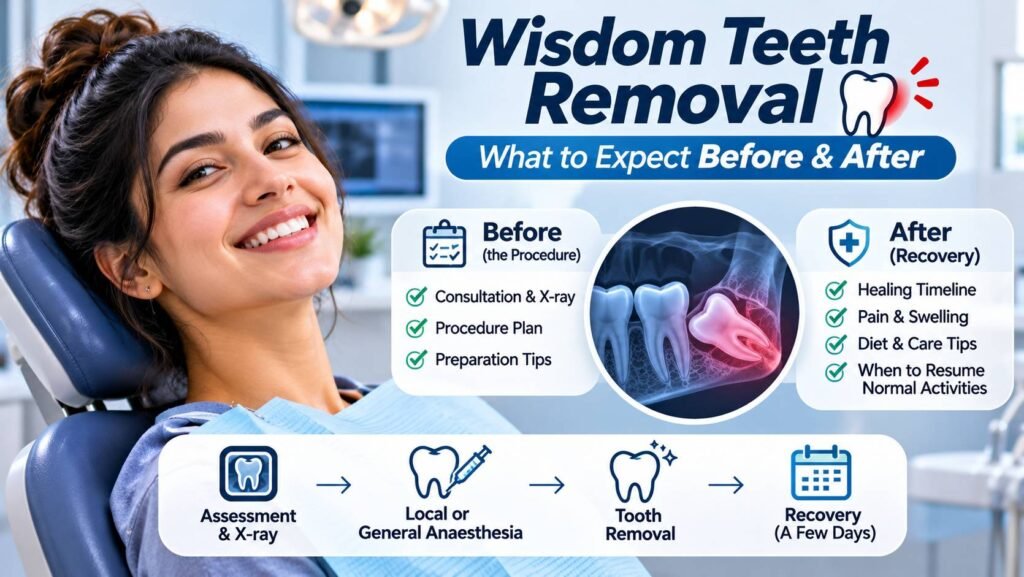
The surgeon reviews your medical history and X-rays, often a panoramic X-ray or a 3D scan, to see the position of the teeth and nearby nerves and sinuses. They’ll discuss anesthesia, risks, and costs.
Anesthesia options
- Local anesthesia: You’re awake, but the area is completely numb.
- Nitrous oxide: Helps you relax while staying awake.
- IV sedation: You’re deeply relaxed and may remember little of the procedure.
- General anesthesia: You’re fully asleep, typically in more complex cases.
See our guide to sedation dentistry for more on each.
Preparing for surgery day
- Follow fasting instructions if you’re having IV sedation or general anesthesia.
- Arrange for a responsible adult to drive you home.
- Wear loose, comfortable clothing with short sleeves.
- Stock up on soft foods, ice packs, and any prescribed medications.
- Plan to rest for at least a day or two.
What Happens During Surgery
The procedure usually takes 45 minutes to an hour for all four teeth, though it varies.
- Anesthesia is given.
- If the tooth is under the gum, a small incision is made.
- Some bone may be removed to reach the tooth.
- The tooth may be divided into pieces to remove it more easily.
- The site is cleaned.
- Stitches may be placed, often the kind that dissolve on their own.
- Gauze is placed to control bleeding.
Recovery Timeline
Everyone heals differently, but here’s a typical pattern.
First 24 hours
- Bite on gauze to control bleeding. Some oozing is normal.
- Use ice packs on your cheeks, 20 minutes on and 20 minutes off.
- Rest with your head elevated.
- Take medications as prescribed.
- Stick to cool, soft foods and liquids.
- Don’t spit, use straws, smoke, or rinse vigorously.
Days 2 to 3
- Swelling usually peaks around day two or three.
- Bruising may appear on the cheeks or jaw.
- Begin gentle warm salt water rinses if your surgeon recommends it, usually after the first 24 hours.
- Continue soft foods.
Days 4 to 7
- Swelling and soreness should steadily improve.
- You may be able to add more textured foods carefully.
- Jaw stiffness gradually eases.
Weeks 1 to 2
- Most people feel close to normal.
- The sockets continue healing beneath the surface for several weeks.
Foods to Eat After Wisdom Teeth Removal
- Yogurt, pudding, and applesauce
- Smoothies, eaten with a spoon, not a straw
- Mashed potatoes
- Scrambled eggs
- Lukewarm soups and broths
- Oatmeal and cream of wheat
- Cottage cheese
- Soft pasta
Avoid crunchy, spicy, very hot, or tiny foods like seeds and rice that can get stuck in the sockets for the first week or so.
Dry Socket: What It Is and How to Avoid It
A dry socket happens when the blood clot in the extraction site dislodges or dissolves too early, exposing bone and nerves. It causes intense pain, usually starting two to four days after surgery, and sometimes a bad taste or odor.
To lower the risk:
- Don’t use straws for at least the first several days.
- Don’t smoke or vape. Smoking is one of the biggest risk factors.
- Avoid forceful spitting and rinsing.
- Follow your surgeon’s instructions carefully.
If you suspect a dry socket, call your surgeon. Treatment usually involves cleaning the site and placing a soothing medicated dressing, which brings quick relief.
When to Call Your Surgeon
- Bleeding that doesn’t slow after several hours of firm pressure
- Pain that gets worse after day three
- Fever
- Pus or a foul taste
- Swelling that increases after day three
- Numbness that doesn’t go away after the anesthesia should have worn off
- Difficulty breathing or swallowing (seek emergency care)
Tips From People Who’ve Been Through It
- Freeze a few smoothies or prepare soups the day before so meals are easy.
- Set alarms for medication times on the first night so pain doesn’t get ahead of you.
- Keep an extra pillow on the bed to stay elevated while sleeping.
- Line your pillow with an old towel in case of drooling or slight oozing.
- Plan movies, audiobooks, or shows for the first two days.
- Don’t schedule big events, exams, or travel for the first few days after surgery.
Possible Risks
Wisdom tooth removal is very common and generally safe, but risks include:
- Dry socket
- Infection
- Temporary or, rarely, lasting numbness of the lip, chin, or tongue due to nerve irritation
- Sinus communication with upper teeth
- Jaw stiffness
Your surgeon will discuss your specific risks based on your X-rays.
How Much Does Wisdom Teeth Removal Cost?
Typical US costs without insurance:
| Type | Typical cost per tooth |
|---|---|
| Simple extraction (erupted) | $100 – $300 |
| Soft tissue impaction | $250 – $500 |
| Partial bony impaction | $300 – $650 |
| Full bony impaction | $400 – $800 |
IV sedation or general anesthesia adds to the cost. Removing all four impacted teeth with sedation can total roughly $1,500 to $4,000. Dental insurance often covers part of the procedure. Medical insurance sometimes contributes in certain cases. See dental care costs in the USA for more.
Helpful sources
- American Association of Oral and Maxillofacial Surgeons: Wisdom teeth
- MouthHealthy by the ADA: Wisdom teeth
- MedlinePlus: Impacted tooth
Medical disclaimer: This article is for general information only and is not a substitute for professional dental or medical advice, diagnosis, or treatment. Always talk with a licensed dentist or physician about your specific situation. If you have severe pain, swelling, or trouble breathing or swallowing, seek emergency care right away. Costs mentioned are general estimates and vary by location, provider, and insurance plan.
Frequently Asked Questions
Does everyone need their wisdom teeth removed?
No. If wisdom teeth are healthy, fully erupted, properly positioned, and easy to clean, they may simply be monitored.
How long does recovery from wisdom teeth removal take?
Most people feel much better within three to five days and close to normal within one to two weeks, though the sockets keep healing for several weeks.
When can I eat normally after wisdom teeth removal?
Many people return to most normal foods after about a week, starting with soft foods and adding texture as comfort allows.
How can I prevent dry socket?
Avoid straws, smoking, vaping, and forceful spitting or rinsing for the first several days, and follow your surgeon's instructions.
Will I be asleep for wisdom teeth removal?
It depends on the case and your preference. Options range from local anesthesia while awake to IV sedation or general anesthesia.
How much does it cost to remove all four wisdom teeth?
For impacted teeth with sedation, the total often falls around $1,500 to $4,000 in the US without insurance.