

“You need a root canal” is a sentence many people dread. The procedure has a long-standing reputation for being painful, but modern root canal treatment is usually about as comfortable as getting a filling. In fact, the treatment is what relieves the pain. The real discomfort usually comes from the infected tooth before treatment.
Here’s a clear look at why root canals are needed, what happens during one, what recovery is like, and what it typically costs.
What Is a Root Canal?
Inside every tooth, beneath the enamel and dentin, is a soft core called the pulp. It contains nerves, blood vessels, and connective tissue, and it runs down through narrow channels in the roots called root canals.
When the pulp becomes inflamed or infected, it can’t heal on its own. Root canal treatment (also called endodontic treatment) removes the damaged pulp, cleans and disinfects the inside of the tooth, and seals it to prevent reinfection. The tooth stays in place and keeps working.
What Causes Pulp Damage?
- Deep decay that reaches the pulp
- A crack or chip in the tooth
- Repeated dental work on the same tooth
- An injury to the tooth, even without visible damage
- A large or leaking filling
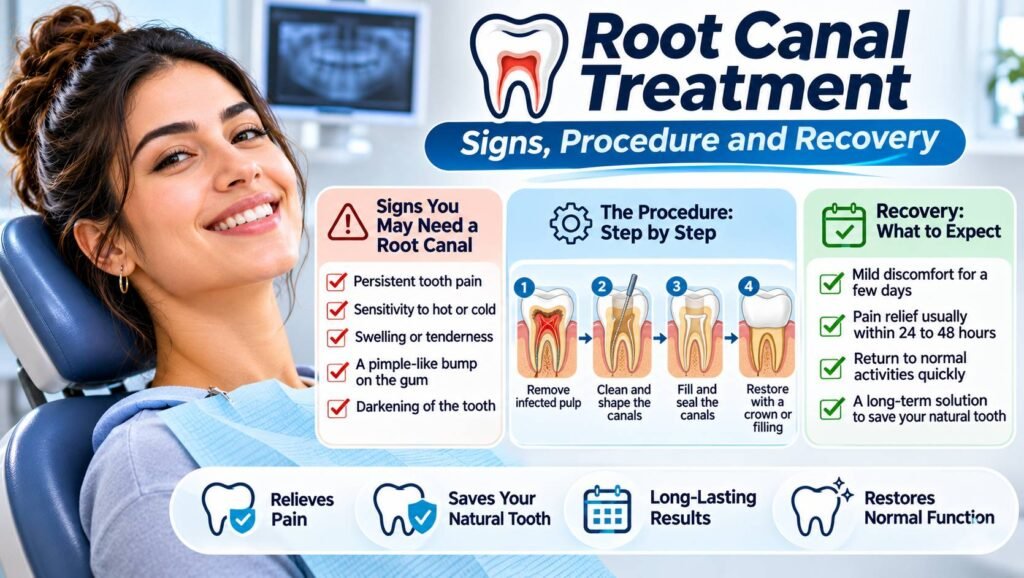
Signs You Might Need a Root Canal
Not every case has obvious symptoms, but common signs include:
- Severe or persistent toothache, especially when chewing
- Lingering sensitivity to hot or cold that stays after the hot or cold is gone
- Swollen or tender gums near one tooth
- A pimple-like bump on the gum that may leak pus
- A tooth that’s darkened compared to its neighbors
- Pain when you touch or tap the tooth
- Facial swelling around the affected area
Sometimes an infection shows up on an X-ray with no pain at all. Your dentist may use tests like cold sensitivity and tapping to see how the nerve is responding. If you have swelling with fever or trouble breathing or swallowing, seek emergency care. See what to do in a dental emergency.
Who Performs Root Canals?
General dentists perform many root canals, especially on front teeth. Endodontists are dentists who complete two or more years of additional training focused on the pulp and root canal treatment. They often handle molars, curved or calcified canals, retreatments, and complex cases. Learn more in endodontists explained.
The Root Canal Procedure, Step by Step
Most root canals take one or two visits, each lasting about 60 to 90 minutes.
1. Exam and X-rays
The dentist confirms the diagnosis and looks at the shape of the root canals. Some offices use 3D cone-beam imaging for complex teeth. More on that in dental imaging technology.
2. Numbing
Local anesthetic numbs the tooth and surrounding area. Very inflamed teeth sometimes need extra anesthetic. If you’re anxious, ask about nitrous oxide or other options. See our guide to sedation dentistry.
3. Isolation
A thin rubber sheet called a dental dam is placed around the tooth to keep it clean and dry and to protect your mouth.
4. Opening the tooth
A small opening is made in the top of the tooth to reach the pulp chamber.
5. Cleaning and shaping
Tiny instruments remove the infected or inflamed pulp and shape the canals. The canals are rinsed with disinfecting solutions.
6. Filling the canals
The cleaned canals are filled with a rubber-like material called gutta-percha and sealed.
7. Temporary or permanent filling
The opening is closed with a temporary filling or a permanent filling. If the infection is severe, the dentist may place medication inside and finish at a second visit.
8. Crown (often)
Back teeth that have had a root canal are more likely to crack, so a dental crown is usually recommended within a few weeks to protect the tooth. Front teeth sometimes only need a filling.
Does a Root Canal Hurt?
With modern anesthetic, most people feel pressure and vibration but not sharp pain during treatment. The American Association of Endodontists notes that patients who’ve had a recent root canal are much more likely to describe it as painless than people who haven’t had one.
Afterward, it’s normal to have some tenderness for a few days, especially when biting. Over-the-counter pain relievers usually help. Call your dentist if you have severe pain, swelling that gets worse, a fever, or your bite feels uneven.
Recovery Tips
- Wait until numbness wears off before eating to avoid biting your cheek or tongue.
- Chew on the other side until the permanent filling or crown is placed.
- Avoid very hard or sticky foods on the treated tooth.
- Take pain relievers as directed.
- Keep brushing and flossing normally.
- Return promptly for your crown if one is recommended. A tooth left with only a temporary filling can crack or get reinfected.
Most people go back to work or school the next day.
How Much Does a Root Canal Cost?
Typical US costs without insurance:
| Tooth | Typical range |
|---|---|
| Front tooth | About $700 – $1,200 |
| Premolar | About $800 – $1,400 |
| Molar | About $1,000 – $1,800 |
Endodontists often charge more than general dentists, and retreatment of a previous root canal usually costs more. The crown is a separate cost, commonly $1,000 to $2,500. Dental insurance often covers root canals as basic or major care. For more, see dental care costs in the USA.
How Successful Are Root Canals?
Root canal treatment has high success rates, and many treated teeth last a lifetime with proper care and a well-fitted crown. Occasionally, a tooth doesn’t heal fully or becomes reinfected. Options then include retreatment or a minor surgery called an apicoectomy, performed by an endodontist.
Root Canal vs. Extraction
Pulling the tooth can seem cheaper and faster, but replacing it later with an implant or bridge usually costs more than saving it. Keeping your natural tooth also preserves your bite and jawbone. Dentists generally recommend saving a tooth when it’s restorable.
Preventing the Need for a Root Canal
Most root canals start with decay or cracks that could have been caught earlier. You can lower your risk by brushing twice daily with fluoride toothpaste, cleaning between your teeth, limiting sugary snacks and drinks, wearing a night guard if you grind, and avoiding chewing ice or hard candy. Regular checkups matter most of all, because a cavity found early can be treated with a simple filling long before it reaches the nerve. See our guide to preventive dentistry.
Myths About Root Canals
- “Root canals are extremely painful.” Modern treatment is typically no more uncomfortable than a filling.
- “It’s better to just pull the tooth.” Saving natural teeth is usually the better long-term option when possible.
- “Root canals cause illness.” This idea comes from outdated research that has been discredited. There’s no valid scientific evidence linking root canal-treated teeth to disease elsewhere in the body.
Helpful sources
- American Association of Endodontists: Root canals
- MouthHealthy by the ADA: Root canals
- NIDCR: Tooth decay
Medical disclaimer: This article is for general information only and is not a substitute for professional dental or medical advice, diagnosis, or treatment. Always talk with a licensed dentist or physician about your specific situation. If you have severe pain, swelling, or trouble breathing or swallowing, seek emergency care right away. Costs mentioned are general estimates and vary by location, provider, and insurance plan.
Frequently Asked Questions
How long does a root canal take?
Most root canals take one or two appointments of about 60 to 90 minutes each, depending on the tooth and the level of infection.
Is a root canal painful?
With modern numbing, most people feel pressure but little or no pain during treatment. Some tenderness for a few days afterward is common.
Do I always need a crown after a root canal?
Back teeth usually need a crown to prevent cracking. Front teeth sometimes only need a filling. Your dentist will advise based on the tooth.
Can I go to work after a root canal?
Most people return to normal activities the same day or the next day.
What happens if I don't get a root canal?
An infection can spread, causing more pain, swelling, and bone loss. The tooth may eventually need to be extracted.
How much does a root canal cost without insurance?
Roughly $700 to $1,800 depending on the tooth, plus the cost of a crown if one is needed.